
Overview
NeuroChain is an AI-native security Layer 1. AI takes part in the protocol at a few well-defined seams — contract audit before deploy and transaction anomaly scoring at the mempool — and never at the point that decides whether a block is final.
What makes it different
| Feature | What it does | Where to read |
|---|---|---|
| VMGuardian | Audits every WASM contract before deploy (rule engine + embedded neural network) and keeps re-auditing deployed contracts. | VMGuardian |
| Sentinel | Scores every incoming transaction for anomalies; an optional policy layer can hold or ask for confirmation instead of rejecting. | Sentinel |
| NeuroWASM | Contract API in the CosmWasm / NEAR class; host functions that let a contract read AI results (scores, certificates, trust lists) are planned. | NeuroWASM |
| Native account abstraction | Sponsored gas and session keys for AI agents — built into the account model, not added on top. | Account abstraction |
| Post-quantum signatures | Every account and every validator signs with ML-DSA-65 (Dilithium3, FIPS 204). | Addresses |
| Identity | An address stays the same while the keys that control it can be rotated. | Identity |
| IBC v2 with post-quantum headers | Transfers and security attestations to other chains (Cosmos first); the counterparty verifies NeuroChain with ML-DSA-65 signatures. Experimental | IBC v2 & sharding |
Architecture

| Layer | Technology |
|---|---|
| Node | Rust, Tokio, RocksDB |
| Consensus | Malachite — Tendermint BFT as a Rust library (Consensus) |
| Contracts | WASM on the wasmi interpreter, fuel-metered gas, host module env |
| Signatures | ML-DSA-65 for accounts and validators |
| AI models | Small neural networks compiled into the node (no_std, no external runtime) |
| Gateway | Node.js + Fastify — REST and WebSocket in front of the node |
| Web app | Quasar / Vue 3 (neurochain-web) |
How a transaction moves
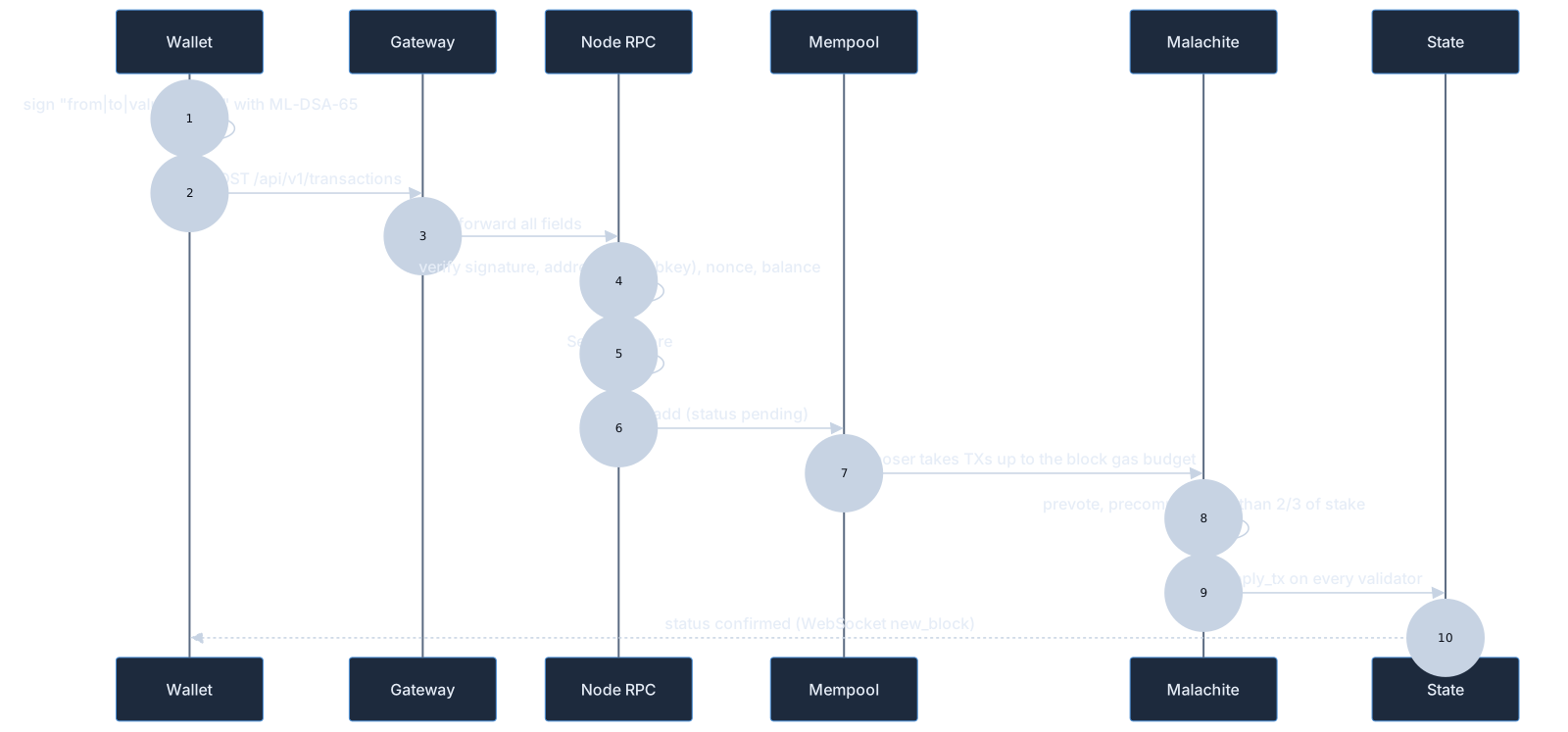
- The wallet signs
nc-tx-v2|from|to|value|noncewith its ML-DSA-65 key — in the browser, through a WASM module. - The gateway forwards the transaction to the node unchanged.
- The node checks the signature, that the address belongs to that key, the nonce and the balance, then scores the transaction with Sentinel.
- The transaction waits in the mempool (status
pending), ordered by fee. - The next proposer puts it in a block; validators vote; once more than 2/3 of the stake has precommitted, the block is final.
- Every validator applies the block the same way and reaches the same state root. The status becomes
confirmed.
Units
All amounts on chain are in uNRO: 1 NRO = 1 000 000 uNRO. API responses carry ready-formatted *_human fields (for example balance_human) — display those rather than converting in the client.
Local ports
The public network is not running yet; examples use a local stack.
| Service | Default port | Override |
|---|---|---|
| Node RPC | 9933 | NEUROCHAIN_RPC_PORT |
| Node P2P | 30333 | NEUROCHAIN_P2P_PORT |
| Gateway (REST + WebSocket) | 3000 | gateway environment |
| Web app | 8080 | WEB_PORT |
| Docs (this site) | 5173 | DOCS_PORT |
Protocol rules that never bend
- AI never changes voting power. The commit quorum is more than 2/3 of stake. AI may only take a validator out (jail or slash to voting power 0), never add weight. See Consensus.
- Contracts identify callers through the host. Use
get_caller(), never acallerfield in the call payload. - Amounts are integers in uNRO. No floating point in balances, fees or stakes.